
Studio / Industries
FMCG & Retail Software Development.
Indonesian retail and FMCG are operating on the largest e-commerce market in Southeast Asia (GMV crossing USD 100B by 2026), under a Halal certification deadline (October 2026 for F&B, pharma, cosmetics), and against the competitive pressure of quick commerce, dark stores, and livestream shopping. We build digital products for operators who have to move fast on omnichannel, loyalty, and supply chain through specialized FMCG & retail software development, while keeping compliance, data, and brand in sync across thousands of SKUs and dozens of channels.
FMCG & retail software development for SEA's biggest, fastest, most competitive consumer market
The Indonesian consumer market is big enough that different operators compete on different dimensions. Convenience chains compete on fill rate and store density. Modern retail competes on omnichannel and loyalty. FMCG competes on availability, forecast accuracy, and trade-marketing velocity. D2C brands compete on experience and retention. QSR competes on same-store traffic and digital ordering. Every one of these translates to a different digital-product priority. We build through custom FMCG & retail software development for the specific job (the retail analytics platform, the mobile loyalty app, the supply chain decision layer, the omnichannel POS refresh), not a generic 'retail digital transformation.'
Signature Visual
The omnichannel retail loop
Circular 6-position loop: store & channel → customer + loyalty → supply chain → demand forecasting → operations & POS → compliance + Halal → back to store. Coming soon.
How we build for retail's operating tempo
Four phases shaped by an industry where execution cadence is weekly, not quarterly.
Discover
Operations audit. Where is the pain: stock-out frequency, loyalty churn, demand forecast accuracy, POS reliability, supplier integration, Halal compliance readiness? We map the operating model (retail chain / FMCG brand / QSR / D2C) and the compliance surface (BPJPH Halal, UU PDP, BPOM for regulated F&B).
Design
Product decisions aligned to operating model. Retail chains need POS + loyalty + inventory integration. FMCG needs demand forecasting + trade marketing + distribution. QSR needs ordering + delivery + loyalty. Don't build the same product and hope it fits.
Build
Senior product engineers with retail-operating context. Integration-heavy (POS, ERP, WMS, PIM, CDP). Observability on critical paths. Weekly-cadence release discipline matched to retail operating tempo.
Scale
Handover to your retail / commerce / ops teams. Runbooks aligned to peak-period operations (Ramadan, Harbolnas, year-end). Halal compliance documentation for BPJPH where applicable. UU PDP data-subject workflows live.
What we build for retail and FMCG operators
Four disciplines that together close the retail loop, rather than each living as its own silo.
Omnichannel & Commerce Products
Store, online, marketplace, WhatsApp commerce, livestream integration. Inventory visibility across channels, unified customer identity, cross-channel returns and loyalty. The product surfaces that make omnichannel real instead of aspirational.
Loyalty, Analytics & Personalization
Loyalty programs that move behavior, not accumulate unused points. Customer analytics that drive category decisions. Personalization that respects UU PDP access rules. Retail analytics for multi-store chains (a Sprout practice category since ComeBy).
Supply Chain & Demand Forecasting
AI-assisted demand forecasting, inventory optimization, dark-store / store-fulfillment routing, supplier integration. The digital layer that turns 'we think we're out of stock in Store 42' into 'Store 42 is out of stock; replenish; here's the forecast error to learn from.'
Halal Supply Chain Traceability & Compliance
BPJPH-aligned Halal traceability for F&B, pharma, cosmetics ahead of the October 2026 deadline. SiHalal 2.0 integration. Product passport and supplier verification infrastructure.
FMCG & retail software development in action
Sprout's retail practice goes back to ComeBy. Here's a cross-section of the work and the market shape.
A retail analytics platform for multi-store operators
We designed and built a retail analytics platform for multi-store operators: category performance, store benchmarking, customer segmentation, promotion analysis. Published case on sprout.co.id under Sprout's earliest retail-sector engagements.
A commerce platform built for SEA network + device conditions
We built the product surface for a Southeast Asian e-commerce platform (browse, cart, checkout, payment integrations), tuned for the network and device conditions Indonesian and regional shoppers actually use. Part of Sprout's public portfolio.
A $100B+ e-commerce market with a hard Halal compliance deadline
Indonesia's e-commerce GMV is crossing USD 100B in 2026 while F&B, pharma, and cosmetics operators face an October 17, 2026 BPJPH Halal certification deadline. Digital traceability via SiHalal 2.0 is the compliance path; operators who modernize supply-chain data now finish on time.
What's trending in Indonesian retail tech
View all insights →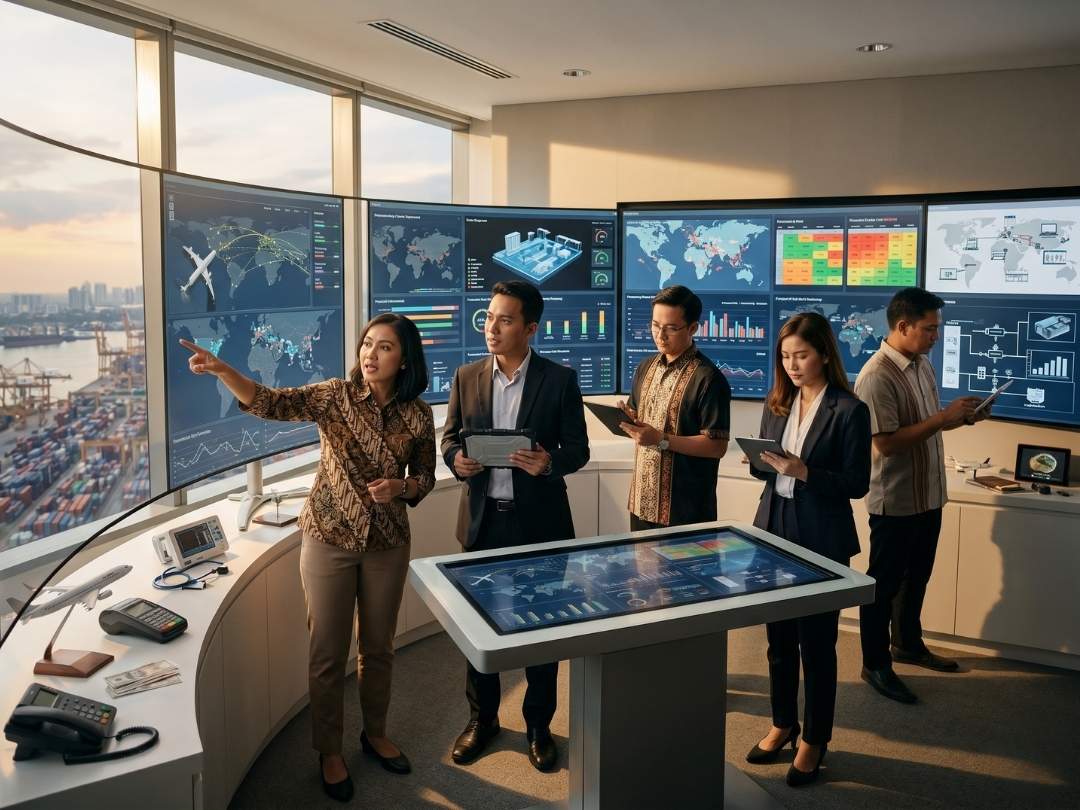
End to End Digital Transformation: Bridging Technical Capabilities and Industry Expertise
Discover how comprehensive product engineering capabilities drive digital transformation across aviation healthcare finance and retail sectors.
Cross Sector Product Engineering: Integrating Technical Expertise with Global Industry Dynamics
Discover how the integration of product strategy design and development drives innovation across aviation healthcare finance and retail sectors.

Retail Digital Transformation: Navigating Consumer Behavior Shifts in the New Economy Era
Optimize your business through retail digital transformation integrating seamless omnichannel experiences smart data analytics and robust backend infrastructure.
Which part of your retail operation needs an FMCG & retail software development initiative right now?
Tell us the state: an omnichannel build, a loyalty refresh, a supply-chain decision layer, a Halal-traceability platform ahead of October 2026, a POS modernization. We'll scope a starting engagement with the operating model, peak-period calendar, and compliance deadlines in scope. Worst case, you get a clear no. Best case, you get a retail product partner who ships at retail's tempo, not an agency's.
Start a project